How Steep Is Too Steep? Trail Gradient Percentages for Mountain Bikers
What 5, 10, 15 and 20 % gradients feel like on a mountain bike, how percent compares to degrees, and how to spot a route's steep parts before you ride.
Quick answer
On a mountain bike, gradients up to about 6 % are steady climbing, 6–10 % is hard but rideable for most riders, 10–15 % needs low gears and good traction, and above 15 % many riders push, especially on loose ground. Gradient in percent is height gained per 100 m ridden — 10 % is about 5.7°, 100 % is 45°. Check the maximum gradient and the steepest climb of a route before you ride it.
Key takeaways
- Rideable limits depend on surface: 15 % on dry asphalt is easier than 10 % on loose gravel.
- Percent is not degrees — 10 % ≈ 5.7°, 20 % ≈ 11.3°, 45 % ≈ 24°, 100 % = 45°.
- Look at the steepest 100–300 m, not only the average gradient of a climb.
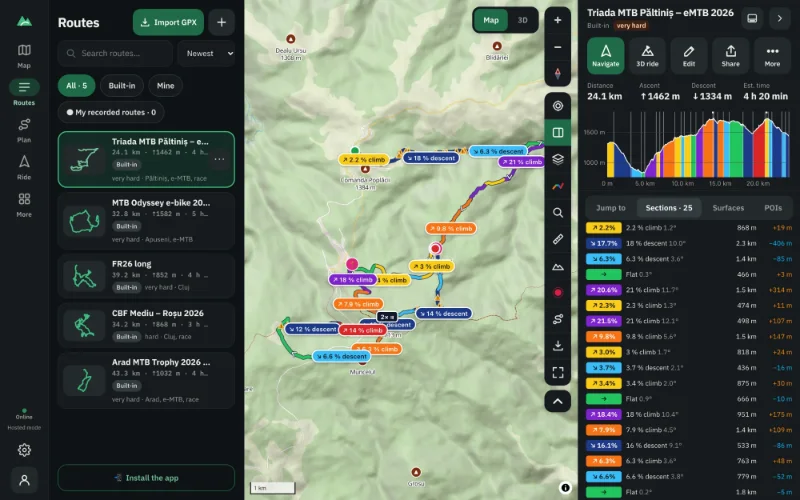
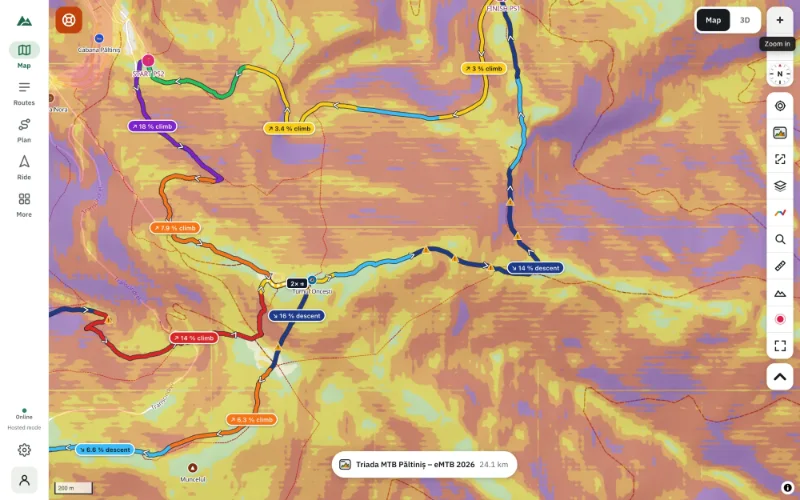
- TrailScout colours every stretch by gradient and lists the steepest climb and descent.
“A 12 % climb” sounds harmless on paper. On loose limestone after 40 km, it is where the walking starts. Knowing what gradient numbers mean in practice is one of the most useful planning skills for mountain bikers. Here is a practical scale, and how to find the steep parts of any route.
What gradient percent means
Gradient is the height you gain (or lose) for every 100 units of horizontal distance. 10 % = 10 m up per 100 m, or 100 ft per 1,000 ft. It is not the angle: a 100 % slope is 45°, not vertical.
| Percent | Degrees | Example |
|---|---|---|
| 5 % | 2.9° | a typical main-road pass |
| 10 % | 5.7° | a steep forest road |
| 15 % | 8.5° | a steep street; hard on any bike |
| 20 % | 11.3° | steep singletrack; traction limit on loose ground |
| 30 % | 16.7° | very steep; most riders push up |
| 45 % | 24.2° | ski-slope steep; slope maps start warning here |
| 100 % | 45° | a 1-to-1 slope |
A practical scale for mountain bikers
TrailScout uses seven gradient classes on the map, the profile and in 3D:
| Class | Gradient | On a mountain bike |
|---|---|---|
| Steep descent | below −8 % | technical, brakes and body position matter |
| Descent | −8 to −2 % | fast and fun; watch your speed |
| Flat | −2 to 2 % | steady pedalling |
| Climb | 2 to 6 % | sustainable for a long time |
| Hard climb | 6 to 10 % | low gears; pace it |
| Steep climb | 10 to 15 % | hard; traction starts to matter |
| Wall | above 15 % | short efforts or walking for many riders |
What makes a gradient harder
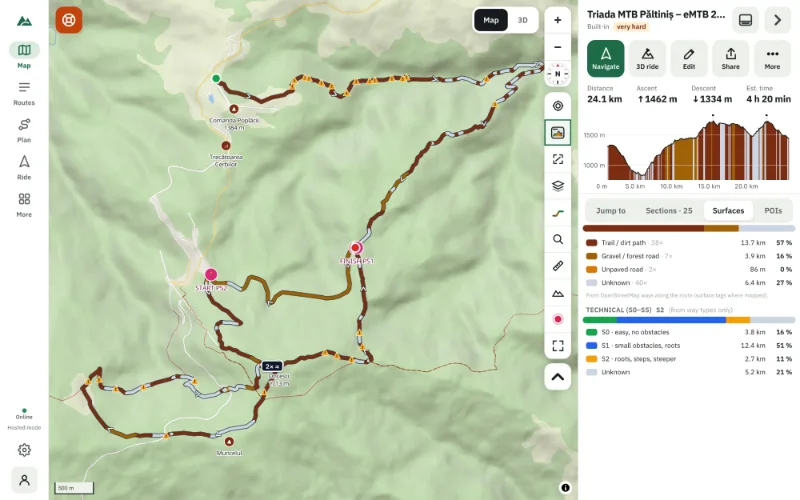
- Surface. Asphalt gives grip; loose gravel, wet roots and rocks take it away. The same 12 % can be easy or impossible. Check the surfaces along the route.
- Length. 15 % for 30 m is a kick; 15 % for 600 m is a test.
- Position in the ride. The last climb of the day always feels steeper.
- Bike and gearing. An e-bike or a 52-tooth cog moves the limit a long way.
- Down is different. −20 % on a smooth fire road is fast; on a rocky trail it is a technical descent.
How to find the steep parts of a route
- Open the route in TrailScout.
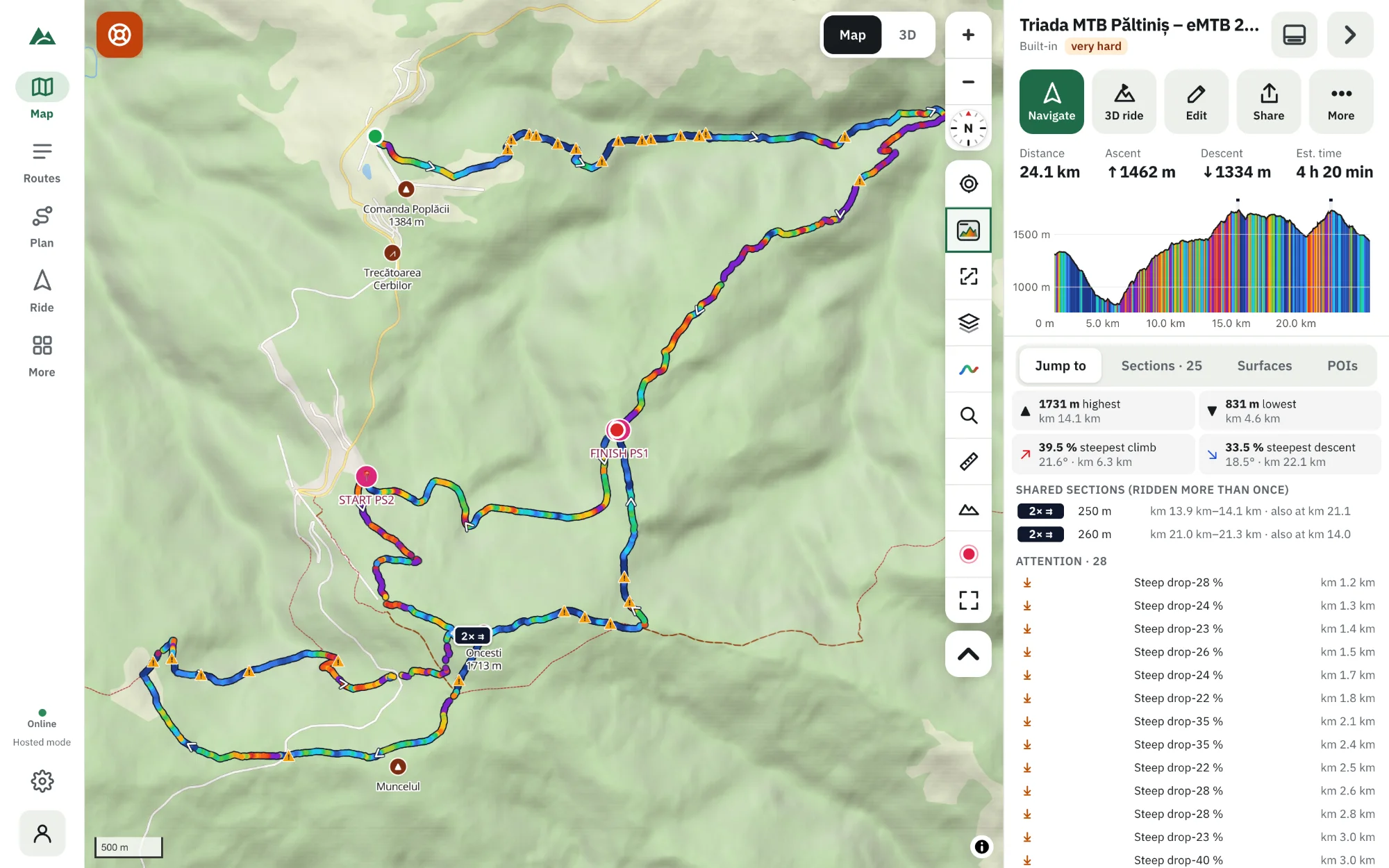
- Read Max gradient above the profile: the steepest stretch of the whole route.
- Open Jump to and choose steepest climb or steepest descent — the map flies there.
- Press G until the colouring is Detailed: every stretch is drawn in its own gradient colour, so short red and black pitches stand out.
- Hover the profile to read the exact gradient at any point.
The maximum gradient is measured over short stretches and smoothed, so a single bad GPS point does not create a fake 60 % wall. If a route still shows impossible numbers, switch its elevation source to Terrain — see how to see a trail's elevation profile.
Gradient of the trail vs slope of the terrain
The gradient of the route is how steep your line is. The slope of the terrain is how steep the mountainside is — a trail can traverse a 40 % slope while staying almost flat. To see the steepness of the ground around a route, turn on slope shading.
Frequently asked questions
What is the steepest gradient you can ride on a mountain bike?
Strong riders on grippy ground can ride 25–30 % for short sections. For most riders on mixed trail, sustained climbs above about 15 % mean walking some of it.
Is 10 % steep for a bike?
Yes — 10 % is a steep climb on any bike. On a forest road most fit riders can ride it in low gears; on loose singletrack it is hard.
How do I convert gradient percent to degrees?
Degrees = arctan(percent ÷ 100). 10 % is about 5.7°, 20 % about 11.3°, 100 % exactly 45°.
Why does my route show a 40 % gradient that I don't remember?
Usually noisy heights from the GPS. Switch the elevation source to Terrain in the route details to recalculate the gradients from the terrain model.
Try it on your next ride
TrailScout is free, needs no account and keeps your routes on your device. It runs in the browser on phones, tablets and computers — and works offline.
Open TrailScout →